
Concrete examples of how partnerships lead to sustainable energy for all
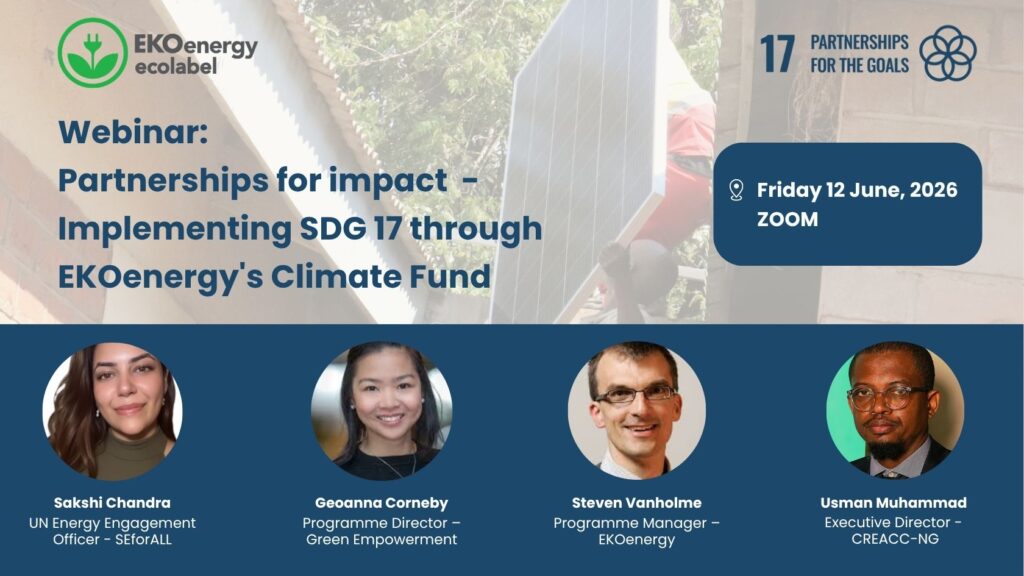
Governments, companies and other stakeholders often express their ambition to promote a just and inclusive energy transition. However, many are struggling to find ways to move from words to deeds. On 12 June 2026, we organised a webinar demonstrating how partnerships function as a practical driver of impact.
The webinar was a side event of the EU Sustainable Energy Week 2026 and part of our commitments in the UN Just and Inclusive Energy Transition Compact.
Speakers from 4 continents illustrated how EKOenergy’s Climate Fund operates through multi-stakeholder collaboration, highlighted the role of different actors (sellers/companies, NGOs, local communities) in enabling project implementation, provided concrete examples of how EKOenergy-funded renewable energy projects improve livelihoods, and offering practical insights on how to engage in effective partnerships
Presentations and quotes
Sakshi Chandra, United Nations – SEforALL
💻 Sakshi Chandra presented without slides
“The clean energy transition is more than a shift in technology. It is a once-in-a-generation chance to build fairer, more resilient societies.”
“However, it is time to move beyond commitments. Operationalizing a just transition requires four things. First. A strong national framework and institutional capacity. Second, financing that actually reaches the vulnerable communities and emerging markets. Third, workforce and skill transitions that create opportunities, especially for youth and women. And fourth, partnerships that ensure local ownership and long-term impact.”
“EKOenergy Climate Fund aggregates smaller contributions and channels them through a transparent process to organizations that communities already trust. It shows that finance doesn’t have to be big to be transformative, but it has to be well-connected. And we need more models like that at every scale.”
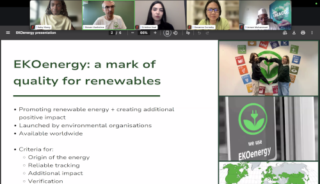
Steven Vanholme, EKOenergy
💻 PDF version of the presentation EKOenergy’s Climate Fund – Connecting stakeholders to enable concrete change (1 MB)
“EKOenergy is all about additional impact. We advocate for more renewables, we reach out to consumers, we set up campaigns, and we have a Climate Fund.”
“Each project inspires others. Neighboring villages, neighboring communities, local politicians, sometimes regional politicians, national politicians, so there is this multiplicator effect of the projects.”
Geoanna Corneby, Green Empowerment, Southeast Asia
💻 PDF version of the presentation Communities in the lead – Just energy transition in Sabah, Malaysia
“Now, what worked in this project? The project worked because of three things. It was led by the community, number one. They worked very hard, contributed time, labor, and resources. And when we honor their expertise, their leadership carries the project from beginning to end, all the way past the lifetime of any grant period. Number two, local partners back these communities. They understand context, they’re part of the social fabric, they are committed to following the community’s lead. And finally, trust from funding partners. Partners like EKOenergy fully trusted the decision of the community and local partners.”
“Our message is that there is no just energy transition without universal electrification. Everyone has to have access to high-quality, reliable, affordable, clean energy. And in this advocacy, our starting point.”
“Because the most powerful thing that happened in this project came from unexpected combinations. A conservation funder, a funder interested in clean energy, just energy transition, Indigenous-led technical organization, fishing community, and all of these coming together, pushing for the same direction because they saw something that mattered. And it’s that same principle that I think will be able to solve the biggest climate challenges of our time.”
Usman Muhammad, Centre for Renewable Energy and Action on Climate Change (CREACC-NG), Nigeria
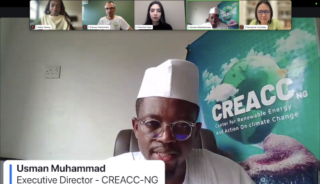
💻 PDF version of the presentation Powering rural communities through partnerships (3.9 MB)
“All these things are very important because before starting implementation, you have to set up systems and uphold checks and balances, such as the Village Elders Committee, women leaders, youth leaders, the district head, and the local government authority. and other relevant authorities. Even the Division Commissioner Police Officer of that local government needs to be involved. So you have key partners that can come together and make sure that this project is being implemented. The traditional rulers play a key role in terms of delivering this project, because when the local leadership, when the traditional leaders speak, they speak to the whole community, and the community listens to them. So without bringing these traditional communities, traditional rulers, traditional institutions in place, then you will have a series of problems.”
“There, young girls travel lots of kilometers, like 5, 10 kilometers, to another village to go and fetch water. So, we provide the system for them. We also provide a charging station for them, because they don’t have access to electricity. They are not connected to the national grid.”
“Successful renewable energy projects are not defined by the number of solar panels installed. They are defined by the strength of the partnership behind them. When communities, government donors, and technical partners work together, energy becomes more than electricity. It becomes a pathway to health, education, livelihoods, dignity, and resilience. That’s the essence of SCG17, and that’s the future we are building together with EKOenergy.”
Recording
The recording of the webinar (1 hour) is embedded below.
(Or, if you don’t see the embedded version, click here: https://youtu.be/iGHzfXeSXD0)
Published: 13 June 2026
